Orlando’s subtropical climate and dense canopy coverage create constant roof rat pressure across Orange County. In established historic neighborhoods like College Park, Thornton Park, and Delaney Park, mature oak trees…
Orlando’s subtropical climate and dense canopy coverage create constant roof rat pressure across Orange County. In established historic neighborhoods like College Park, Thornton Park, and Delaney Park, mature oak trees form overhead bridges directly onto barrel tile and asphalt shingle roofs. A roof rat requires an opening of only 0.5 inches, roughly the size of a quarter, to compress its body through construction gaps, soffit junctions, or plumbing stacks. Standard bug-spraying protocols and interior pesticide saturation do not solve mammalian intrusions; toxic baits placed inside an attic frequently cause rodents to expire deep within drywall cavities, generating severe odor events and secondary dermestid beetle infestations in temperatures exceeding 120°F.
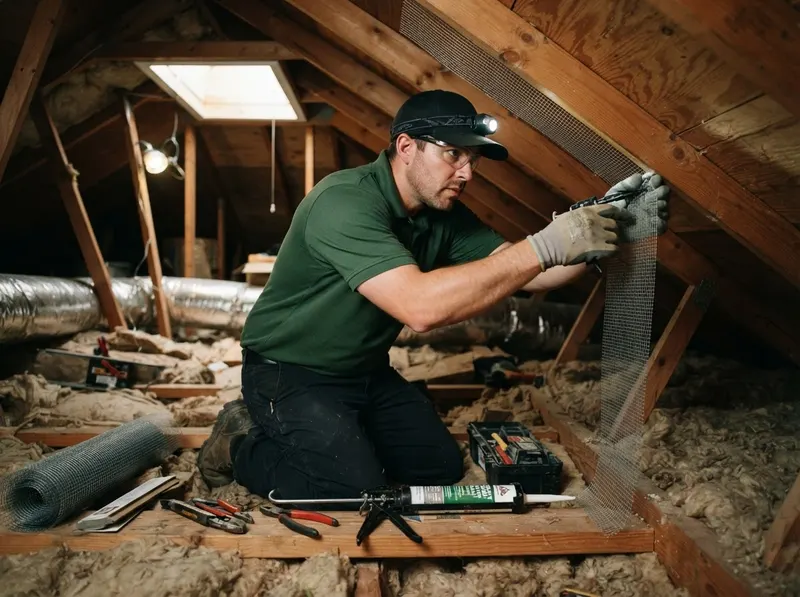
Effective attic rodent exclusion prioritizes mechanical closure over continuous chemical broadcast. The protocol fits homes experiencing scurrying sounds in ceilings between dusk and dawn, shredded ductwork insulation, or dark grease marks along fascia boards. For newer builds in Lake Nona and Baldwin Park, entry points typically concentrate around builder gap flaws where roof decking meets the fascia, as well as unmeshed off-ridge attic vents. In properties around MetroWest, Rosemont, Audubon Park, and Dr. Phillips, heavy vegetation and architectural tile roof corners offer immediate access to air-conditioning chase pipes. Closing these gaps requires custom-cut 0.25-inch galvanized hardware cloth, copper mesh stuffing, and silicone-based metal sealants that rodents cannot chew through.
The process follows four distinct mechanical phases: 1. A physical attic walk to map runway points, fecal contamination, and gnawed electrical wiring. 2. Placement of snap traps along monitored travel joists; snap traps allow verified carcass removal without indoor odor risks. 3. Sealing of all secondary ground and roofline gaps while maintaining an open primary one-way exit or concentrated trapping zone. 4. Complete perimeter closure of the primary aperture once trap counts remain at zero for 72 consecutive hours. Homeowners face a direct structural trade-off between exterior architectural sealing and long-term trap maintenance: continuous trapping without structural exclusion guarantees recurring seasonal invasions as surrounding colonies replenish.
Every job gets a firm, written price after a free on-site visit.
Tell us about your attic rodent exclusion job in Orlando and we'll send a clear, written quote, usually the same day.
 SureNest Pest Control