Drywood termites (Cryptotermes brevis) do not require soil contact to colonize structural timber, deriving all survival moisture directly from the relative humidity of the surrounding air and the lumber itself. In…
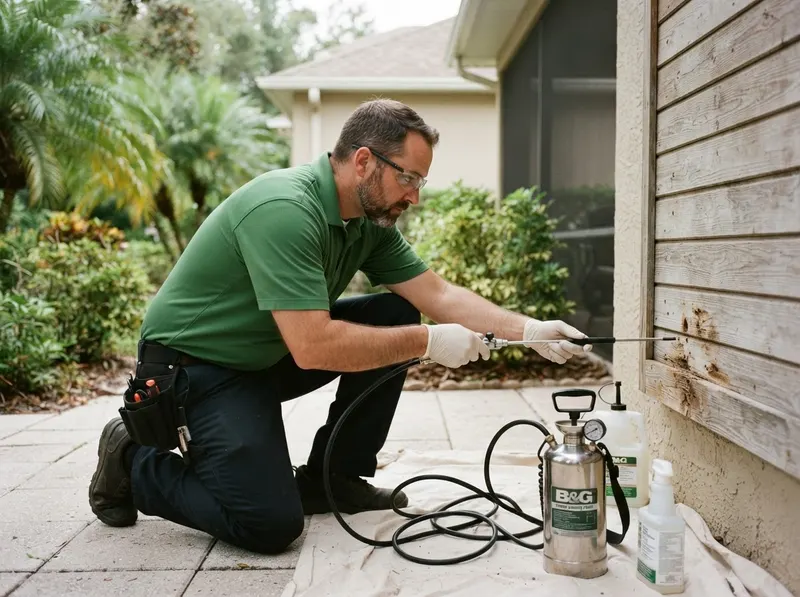
Drywood termites (Cryptotermes brevis) do not require soil contact to colonize structural timber, deriving all survival moisture directly from the relative humidity of the surrounding air and the lumber itself. In historic Orlando properties, such as 1920s craftsman bungalows in College Park, Thornton Park, and Delaney Park, drywood swarmers commonly infiltrate attic vents, exposed fascia boards, and unsealed door assemblies following warm spring rains. Spot treatment serves as a minimally invasive, localized countermeasure designed to eradicate isolated colonies without displacing residents, packing pantry foods, or requiring overnight tent fumigation.
Local spot treatment relies on targeted precision rather than broad-spectrum surface sprays. Technicians identify active galleries by locating six-sided fecal pellets (frass) expelled through microscopic kick-out holes. Once acoustic listening sensors or localized thermal readings confirm the active chamber, operators drill small access channels directly into the colonized void. A pressurized, non-repellent termiticide or expanding borate foam is injected through the channel. The expanding formulation fills the structural network, coating the workers, soldiers, and reproductives directly while transferring lethal active ingredients across grooming cycles throughout the entire gallery.
Decision guidance dictates treatment fit based on structural containment. If termite activity is isolated to one or two accessible timbers, such as an attic beam in Audubon Park or a single window casing in Baldwin Park, spot treatment provides structural protection while avoiding the expenses and logistics of whole-house tenting. The trade-off is geographic scope: spot treatment only eradicates termites inside the targeted wood members and cannot protect remote, uninspected voids elsewhere in the structure. Properties exhibiting widespread kick-out points spanning multiple distinct elevations or inaccessible roof purlins require comprehensive fumigation rather than localized remedial injections.
Every job gets a firm, written price after a free on-site visit.
Tell us about your drywood termite spot treatment job in Orlando and we'll send a clear, written quote, usually the same day.
 SureNest Pest Control